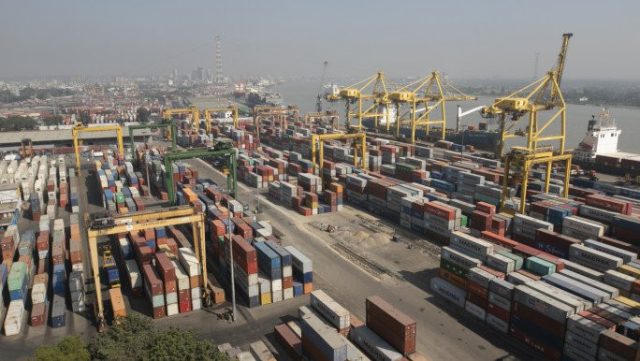

From Our Correspondent, CHATTOGRAM: Public concern is growing over the so called “workers’ movement” surrounding the proposed leasing of the New Mooring Container Terminal (NCT) at Chattogram Port. Although work stoppages over the past several days have severely disrupted port operations, many observers argue that the protests are not driven by workers’ interests. Instead, they claim a long entrenched and influential syndicate is operating from behind the scenes to protect its dominance.
According to informed sources, efforts to modernize the port and introduce a competitive operating environment threaten the control of existing interest groups. Fearing the loss of authority and financial benefits, a particular group is allegedly pushing workers to the forefront of the protests to safeguard its own interests.
National interest or vested interests

While labor leaders opposing the NCT lease have framed their stance in terms of patriotism and protection of national assets, stakeholders say the reality is different. They argue that engaging experienced foreign operators would significantly enhance efficiency at the port and put an end to decades old syndicate control. It is precisely this prospect, they claim, that has prompted certain powerful actors to mislead workers and mobilize them on the streets.
Business community members question why labor unrest emerges whenever initiatives are taken to modernize the port. They also ask why there has never been a movement demanding the dismantling of syndicates controlling berth operations and ship handling.
Call for a thorough investigation
Business leaders and industrialists stress that identifying those who are holding the country’s primary economic gateway hostage has become essential. They argue that individuals inciting workers and pushing the import export sector toward instability must be exposed.
They emphasize that this is not merely an issue of livelihood for a few thousand workers. Rather, it raises serious questions about whether the unrest is being used to enrich a small group at the expense of the national economy. A high level, impartial investigation is widely seen as necessary.
Port under syndicate control
For decades, berth operating and ship handling activities at Chattogram Port have reportedly remained under the control of a limited number of licensed entities. Allegations suggest that these groups have enjoyed political patronage and maintained a monopoly over operations for years.
Strategic tenders and an ‘legal shield’
Investigations reveal that although tenders for berth operators are issued periodically, the process effectively excludes most potential participants.
The tender conditions are often crafted with highly specific and complex requirements that only current syndicate members can meet. As a result, capable and efficient new operators are unable to enter the market, despite formal claims of open competition.
Business leaders describe the process as largely symbolic. On paper, it appears competitive, but in practice, control continues to circulate among the same few entities. This invisible barrier, they note, has never been challenged by labor organizations or protest committees.
They also argue that container and cargo handling is not an overly complex technological task. With an open market, competition could reduce handling costs significantly. Such reductions would directly benefit importers, industrialists, and consumers across the country. However, the entrenched syndicate remains the main obstacle to establishing a truly competitive environment.
Although Chattogram Metropolitan Police have imposed a ban on assemblies in the port area, those allegedly instigating the unrest remain beyond reach. For the sake of the national economy, there is growing public demand for a neutral and rigorous investigation into both the NCT leasing process and the real objectives behind the ongoing protests.