

From Our Correspondent, Chattogram: Maintaining environmental compliance in the global shipping industry has become an increasingly complex challenge. To sidestep strict regulations, many shipowning companies are exploiting a well known practice called the Flag of Convenience, commonly referred to as FOC. According to the NGO Shipbreaking Platform, this mechanism has effectively turned into a legal shield that allows shipowners to avoid environmental and social responsibility.
Understanding the Flag of Convenience
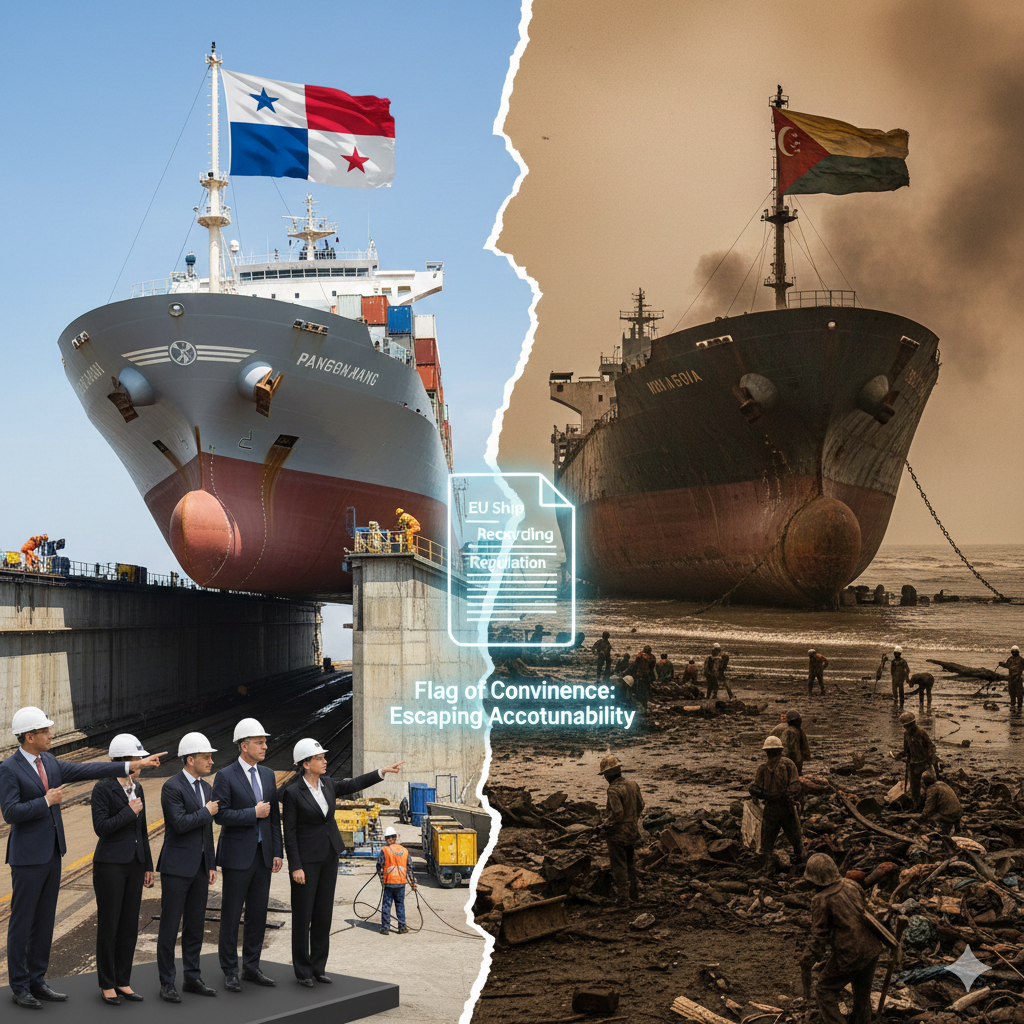
Under normal circumstances, a vessel sails under the flag of the country where it is officially registered. However, in reality, many ships owned by companies based in developed European countries are registered in developing nations such as Panama, Liberia or Comoros. This arrangement is known as the Flag of Convenience.
By choosing these flags, shipowners can operate under weaker regulatory frameworks, even though the real ownership and financial control remain in Europe.

Why Shipowners Choose FOC
There are two main reasons behind the widespread use of the Flag of Convenience.
The first is to avoid strict legal obligations. The European Union Ship Recycling Regulation is highly stringent. Ships flying an EU flag must be dismantled only at EU approved safe recycling yards, which follow strong environmental and labor safety standards.
The second reason is cost reduction. Shortly before a vessel reaches the end of its operational life, owners often change its flag to a country with lax regulations. This enables them to send ships to South Asian beaches for dismantling using the beaching method, which is significantly cheaper but banned under EU law.
Legal Gaps Fueling the Crisis
International maritime regulations are largely based on the concept of the flag state. This means that responsibility lies with the country under whose flag the ship is registered. As a result, even if a vessel is owned by a European company, EU authorities cannot enforce their regulations if the ship flies a non EU flag.
This legal loophole has allowed many companies to prioritize profit over environmental protection and the safety of shipbreaking workers.
Rethinking Accountability
Experts and the NGO Shipbreaking Platform argue that the current system is no longer effective. They emphasize that focusing solely on the flag state ignores the reality of global ship ownership structures and enables regulatory evasion.
Three Practical Solutions
To address the problem, experts have proposed three key measures.
First, enforcement based on beneficial ownership. Instead of focusing on the registered flag, laws should target the actual owner of the ship. If the beneficial owner is a European company or based in an EU country, the vessel should be required to comply with EU environmental standards regardless of its flag.
Second, introducing a financial guarantee or levy. Ships entering or operating in EU ports could be required to deposit a fixed amount into a recycling fund. This money would only be refunded if the vessel is eventually recycled at an approved safe yard, creating a strong incentive for responsible behavior.
Third, strengthening port state control. Surveillance and inspections at EU ports should be intensified. Ships that engage in end of life flag switching to bypass regulations should face heavy fines and possible bans from future port access.
The Road Ahead
Achieving sustainability in the global shipping industry requires moving beyond a flag based regulatory system. Holding real owners accountable is now essential. Without such reforms, the Flag of Convenience will continue to undermine environmental protection, increase marine pollution and put the lives of shipbreaking workers at risk worldwide.