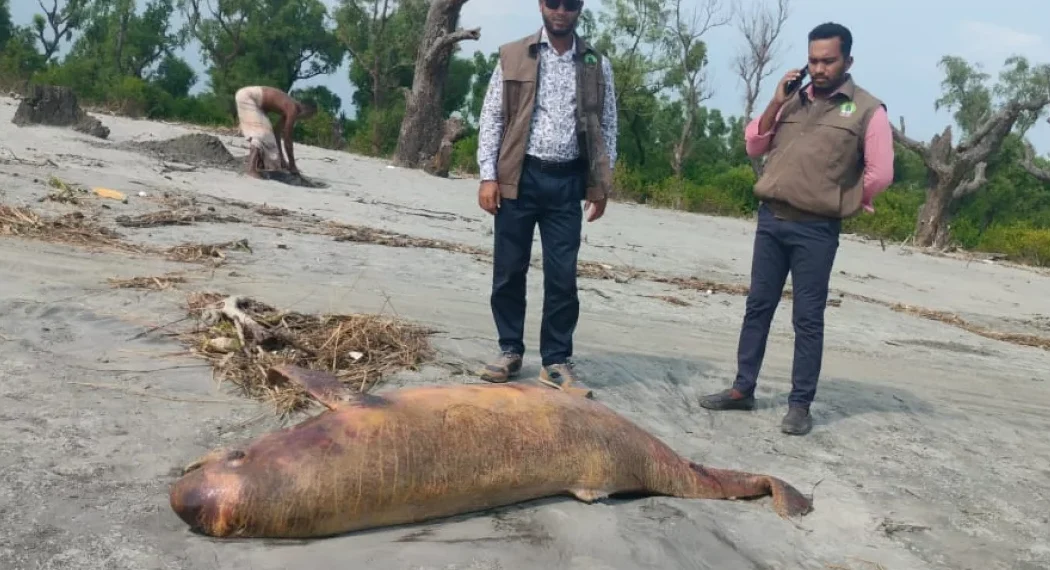

From Our Correspondent, Patuakhali: A dead dolphin has once again washed ashore at Kuakata Sea Beach. On Friday morning, members of the local Dolphin Protection Committee found the carcass lying in the Swopnorajjo Park area on the western side of the beach. As the skin of the dolphin had already peeled off and a strong foul smell was spreading, it is believed that the animal died several days earlier.
To avoid health risks, the dolphin was buried quickly in the presence of the Forest Department and environmental organizations. Local environmentalists said that although awareness campaigns are continuing to protect dolphins in coastal areas, the series of deaths is not stopping. Because proper scientific post-mortems and investigations are not being carried out, the real reasons behind these deaths remain unknown.
Experts say there could be several scientific reasons behind dolphin deaths along the Kuakata and Bay of Bengal coast.

One major cause is getting trapped in fishing nets, known as bycatch. Dolphins are mammals and must come to the surface regularly to breathe. If they become trapped in deep-sea fishing nets, especially gill nets, they cannot surface and eventually die from lack of oxygen. Skin damage or injuries are often caused by friction with the nets.
Another important reason is underwater noise pollution and the impact of sonar. Dolphins depend on echolocation to move and hunt. Loud sounds from large ship engines, seismic surveys for mineral exploration, and other high-intensity sound waves can damage their hearing and navigation abilities. As a result, dolphins become disoriented, move into shallow waters, and sometimes get stranded on beaches and die.
Environmental toxins and infectious diseases are also possible causes. Plastic pollution and chemical waste in the sea can create long-term poisoning in dolphins. In some cases, toxins released during harmful algal blooms, known as red tide, affect the nervous system of dolphins. Because the body was already decomposed, it is important to test whether any infectious virus, such as morbillivirus, played a role in this death.
Changes in the physical and chemical condition of seawater can also be responsible. Due to climate change, sudden changes in water temperature or salinity can make it difficult for dolphins to adapt. During winter or seasonal transitions, changes in coastal currents often carry dead bodies toward the shore.
There are also serious environmental and public health concerns. Harmful bacteria and viruses can spread from a dead dolphin, creating risks for local people and other animals. Therefore, burying the dolphin quickly was the right decision.
Environmentalists say that to know the real cause of death, a proper necropsy and laboratory tests are necessary. They also demand that parts of the sea near Kuakata be more strictly monitored and protected as dolphin sanctuaries to prevent further losses.