
Skuld and IMB Warn: Ransom Payments Fueling Resurgence in Maritime Crime
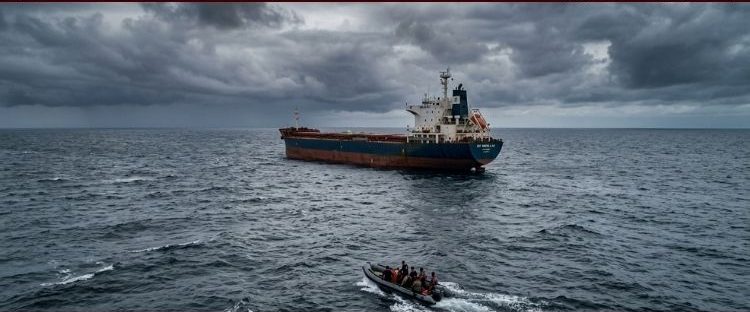
From Our Correspondent, Chattogram: The estimated $5 million ransom paid in April 2024 for the release of the Bangladeshi vessel MV Abdullah has emerged as a significant threat to Indian Ocean security. International maritime security agencies and insurance providers claim this substantial payout has not only financially bolstered Somali pirates but has also severely incentivized them to orchestrate larger criminal operations.
A Lucrative Business: The Skuld Warning
Skuld, a leading global marine insurance provider, highlighted the MV Abdullah incident in its special report released in November 2025. The report noted, “The $5 million paid for the release of MV Abdullah in April 2024 reaffirmed the profitability of piracy. This is tempting pirates to launch fresh attacks.” According to Skuld’s analysis, after a long hiatus, this sum is acting as ‘seed capital’ for pirate networks.

‘Window of Opportunity’ and Advanced Equipment
Denmark-based Risk Intelligence noted in its recent observations that the MV Abdullah ransom has opened a ‘window of opportunity’ for Somali pirates. According to their findings:
- The funds are being utilized to procure more sophisticated weaponry than before.
- Pirates are increasing their fleet of hijacked ‘motherships’ to sustain operations in the deep sea for longer durations.
- A significant portion of the money is being spent on high-tech GPS and communication equipment.
Global Agency Concerns
The ICC International Maritime Bureau (IMB), in its 2024 and 2025 annual reports, mentioned that the rising graph of piracy in the Indian Ocean is primarily driven by the ‘financial lure’ of large ransoms.
The Maritime Security Centre – Horn of Africa (MSCHOA), an EU naval security agency, echoed these concerns. The organization stated that pirate activity far from the Somali coast has increased since the ransom payout. This clearly indicates that following the MV Abdullah incident, pirates are now emboldened to take higher risks and are investing funds into long-term missions.
Analysts believe that while paying ransom is a humanitarian necessity to save sailors’ lives, it pushes international waterways into long-term peril. The instability created in the Indian Ocean following the MV Abdullah ransom now requires double the patrol and surveillance efforts from international navies to maintain control.