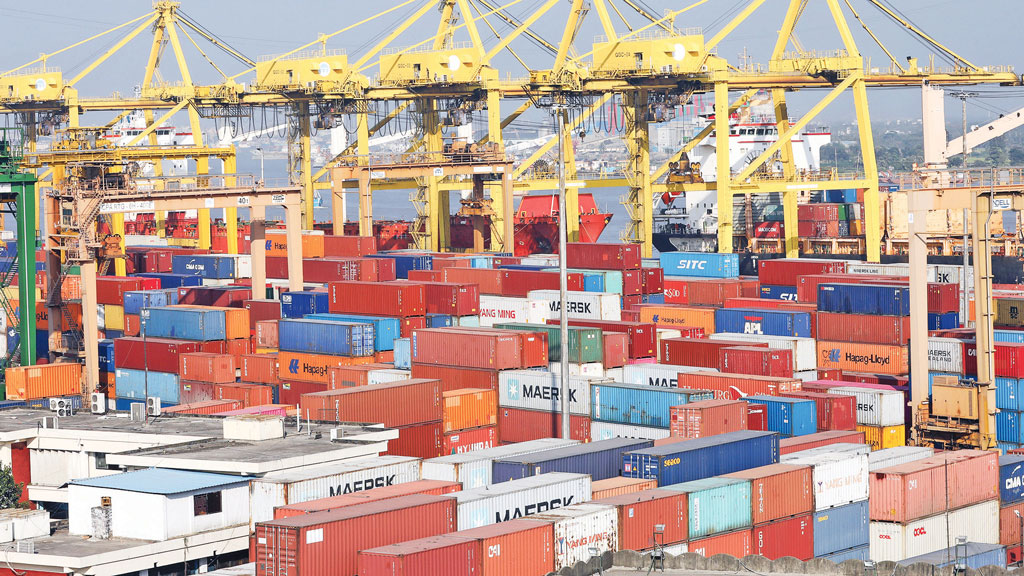

From Our Staff Correspondent, CHITTAGONG: The official process has commenced to hand over the operations and maintenance of the Newmooring Container Terminal (NCT)—widely recognized as the most modern and profitable terminal at the Chittagong Port—to Dubai-based global port operator giant, ‘DP World’. While a section of port users has expressed concern over the government’s decision to engage this international powerhouse under the Public-Private Partnership (PPP) model, economists and port experts view the transition as a highly positive and groundbreaking step for the nation’s economic future and port modernization. Experts strongly emphasize that introducing a world-class operator is the only viable alternative to liberate the country’s primary maritime gateway from the tight grip of a domestic corporate syndicate that has persisted for years.
Chittagong Port Hostage to Syndicated Interests Allegations have surfaced indicating that the operations of the NCT at Chittagong Port have remained heavily confined within a handful of specific domestic companies for over a decade. This prolonged monopolistic dominance and syndication have effectively hindered the adoption of advanced technologies and the establishment of international management standards at the port. Despite generating thousands of crores of taka through minimal investments, this circle has completely failed to enhance the overall capacity of the port or forge strategic alliances with major global shipping lines. Because of this syndicate, massive foreign logistics and shipping corporations have continuously faced multifaceted complications, including extensive delays in anchoring vessels. Observers note that this very syndicate is currently attempting to pressure the government under the guise of a newly formed ‘consortium’ purely to sustain its monopoly, which directly threatens the modernization and globalization of the port.
DP World’s Global Footprint and Terminal Transformation Investigative findings reveal that DP World stands out as one of the world’s leading port and terminal operators, currently managing port infrastructures successfully across more than 70 countries. Wherever DP World has assumed operational responsibilities, those ports have witnessed revolutionary advancements in both physical infrastructure and operational efficiency.

London Gateway (United Kingdom): Following DP World’s takeover, this terminal transitioned into the United Kingdom’s most sophisticated and fully automated port. By integrating cutting-edge technology with seamless logistics chains, vessel turnaround and cargo unloading times were slashed by nearly half, injecting significant momentum into the British economy.
Jebel Ali Port (Dubai): The transformation of this premier Middle Eastern maritime gateway into one of the busiest and most efficient ports globally is rooted in DP World’s visionary management. Driven by one hundred percent digital customs procedures and automated terminal management, it has firmly established itself as a central hub for global commerce.
Ports Across India and the African Continent: In India, container handling capacities expanded exponentially at both the Jawaharlal Nehru Port and Chennai Port through the integration of DP World’s modern technological frameworks. Furthermore, their strategic investments and expansive logistics networks in African nations like Rwanda and Senegal have successfully elevated historically underdeveloped ports to strict international standards.
Why DP World’s Entry into NCT is Imperative Port specialists strongly assert that appointing an organization like DP World to manage the NCT will fundamentally redefine the operational landscape of Chittagong Port due to several critical factors.
Automation and Technological Excellence: DP World will introduce proprietary technologies to fully automate terminal operations. This will facilitate entirely paperless transactions and ensure the fastest possible container clearance times, contrasting sharply with the sluggish processes observed under the domestic syndicate.
Direct Foreign Investment (FDI): Under the structured PPP model, DP World will inject substantial private capital to deploy state-of-the-art machinery, including automated cranes and advanced container scanners. Consequently, the government will not need to allocate public funds from its own exchequer, while state revenue generation is projected to multiply significantly.
Attracting Major Global Shipping Lines: DP World’s expansive global network will naturally incentivize the world’s leading shipping lines and mega-vessels to call directly at the Chittagong Port. This shift will drastically reduce Bangladesh’s systemic dependence on feeder ports like Singapore or Colombo, causing import and export freight costs to plummet instantly.
Development of Skilled Human Resources: The arrival of a foreign operator will not diminish local employment opportunities for thousands of port workers. On the contrary, local laborers will gain access to international-standard training modules, thereby fostering a highly skilled workforce within the domestic logistics sector.
The primary economic engine of a nation cannot remain indefinitely hostage to the commercial interests of a few local companies. To thrive in an increasingly competitive global market and to sustain Bangladesh’s GDP growth trajectory, appointing an experienced, efficient, and globally recognized operator like DP World at the Chittagong Port’s NCT remains the definitive need of the hour.
Please follow businesstoday24.com to stay updated with more exclusive reports, and feel free to leave your valuable comments below.